
Lazy Summer x Utila: Automated, diversified access to DeFi yield for institutions

TLDR: Lazy Summer Protocol is now available through Utila's institutional wallet solution. Utila clients, top-tier institutions: treasuries, Digital Asset Treasury Companies, fintechs, and stablecoin issuers, can now deploy stablecoins into diversified, risk-managed DeFi vaults without leaving their wallet environment.
Capital is automatically allocated across leading DeFi lending markets, rebalanced by AI-powered Keepers, and governed within a risk framework curated by Block Analitica.
Institutional access to diversified onchain yield
For the forward-thinking institutional players in digital assets, simply holding stablecoins on a balance sheet is no longer enough.
Onchain yield via lending markets, vault strategies, and specific DeFi protocol allocations is fast becoming a treasury management function, sitting alongside exposure management and liquidity planning as a core operational lever.
For treasuries, Digital Asset Treasury Companies, fintechs, and stablecoin issuers, DeFi yield strategies can allow institutions to put idle capital to productive use within onchain markets.
But to date, accessing DeFi yield under the governance, compliance, and reporting standards these institutions require has been a fundamental challenge solved by platforms like Utila.
The opportunity cost of a single yield source strategy
DeFi yields, like returns in any other market, live on a spectrum of risk. And that spectrum is dynamic, rates shift with borrow demand, liquidity flows, incentive programmes, collateral composition, and broader market conditions. A strategy yielding 8% today can compress to 3% within weeks as capital rotates or incentives expire.
For an institution evaluating whether to deploy capital onchain, this creates a difficult calculus. A single vault or a single protocol may deliver only a portion of the available risk-adjusted return, while exposing the institution to the full operational and smart contract risk of that deployment.
Why take on the compliance burden, the technical overhead, and the operational complexity of DeFi for a yield that periodically underperforms what is available elsewhere onchain at similar or lower risk?
- For a Digital Asset Treasury Company reporting to public shareholders, underperformance against available yield is a line item that analysts and boards will scrutinise.
- For a fintech offering yield as a feature, it undermines the value proposition.
- For a stablecoin issuer deploying reserves, it leaves revenue on the table.
Therein lies the single biggest problem institutions face when deploying capital for onchain yield - capital either stays idle, or remains deployed in a deteriorating position because the cost of monitoring and rotating exceeds the benefit.
Concentration risk: the shadow side of a single yield source
The other side of single strategy deployment is the concentration risk it introduces. Capital becomes exposed to at least one point of extreme concentration - a single protocol, a single risk manager, or in the worst case, a single yield source with a small underlying pool of borrowers.
DeFi operates with transparent and verifiable mechanics, but also with risks specific to the ecosystem: smart contract vulnerabilities, oracle failures, governance decisions, and liquidity crunches during periods of volatility, concentration in any one venue amplifies all of these risk vectors. A governance vote, a parameter change, or an exploit in a single protocol can materially impair an entire allocation overnight.
Traditional finance solved this problem decades ago through diversification across counterparties, durations, and asset classes. The same principle applies onchain, but the infrastructure to implement it at institutional scale has, until recently, not existed.
Fragmentation and the cost of going it alone
So what can institutions do? The alternative to date has been to build the capability internally; hiring dedicated DeFi teams to conduct due diligence on protocols, monitor risk parameters, track governance proposals, optimise gas costs, and manually rotate capital across venues.
The scale of this task is not trivial, as we've written about before in The DeFi Yield Landscape: A Map of Fragmentation, the current landscape spans 58 protocols across 9 blockchain networks, with 20+ yield-bearing assets and 11+ independent risk curators.
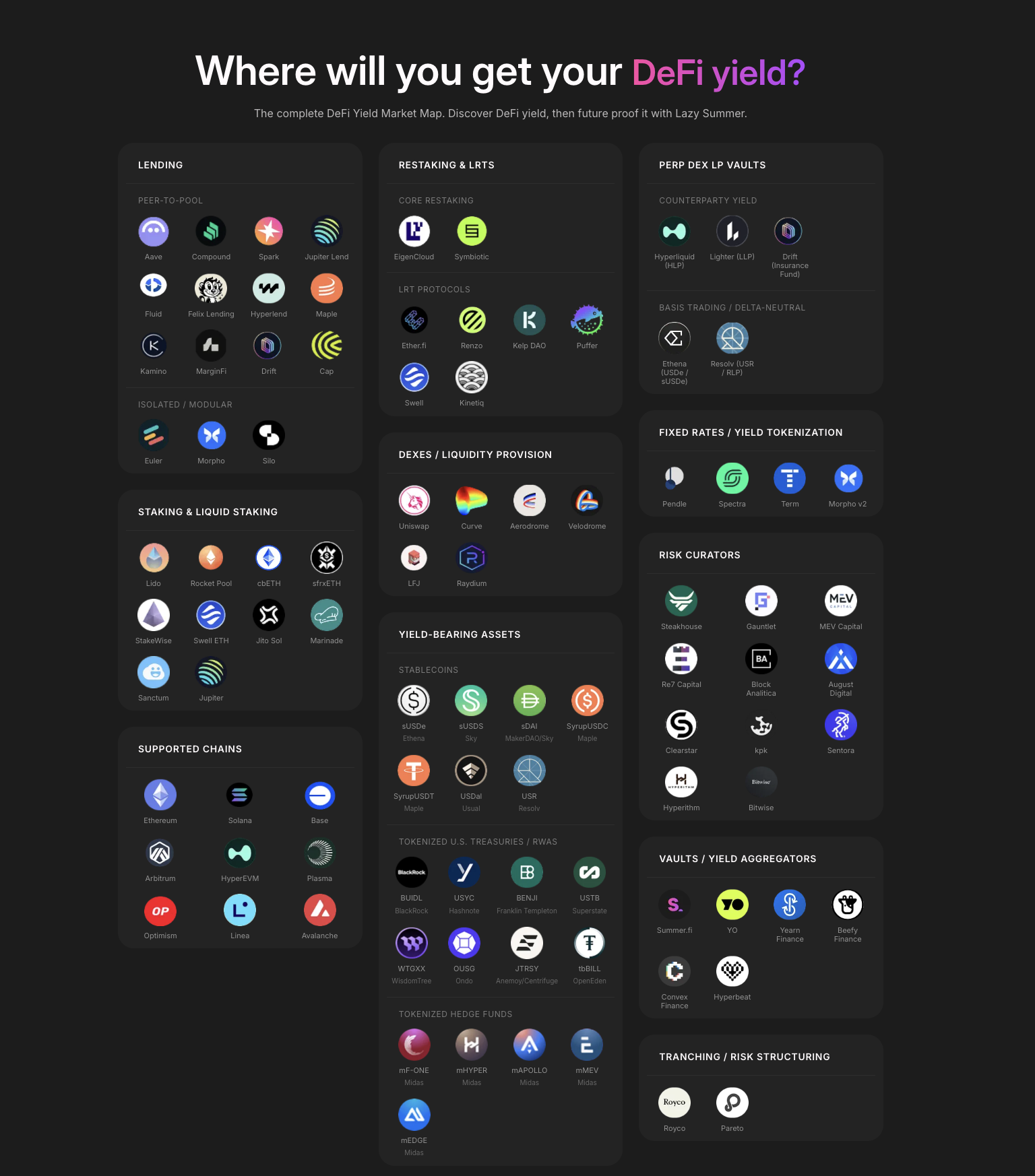
All with rates that shift daily, gor a single asset like USDC on Ethereum alone, an institution would need to evaluate yields across Aave, Compound, Spark, Fluid, multiple Morpho vaults with different curators, and Euler, before even considering other chains.
Most treasury teams are simply not structured to run what amounts to a full DeFi operations desk with 24/7 coverage across that surface area.
The Gauntlet x Utila report on DeFi yield for Digital Asset Treasury Companies frames this clearly: the gap isn't access to DeFi, the gap is infrastructure. The ability to deploy capital into professionally curated, risk-managed strategies within a custody and governance framework that meets institutional standards.
Utila x Lazy Summer: The best risk-adjusted DeFi yield, now available for any kind of institution
Today, Lazy Summer Protocol is available on Utila, bringing its full vault infrastructure to institutional clients.
Utila is the digital asset operations platform used by over 250 global institutions to securely manage stablecoin and digital asset operations. It provides MPC-based self-custody, a configurable policy engine for governance and approvals, and integrated compliance tooling, essentially the operating system for institutional-grade digital asset management.
What Utila clients get access to
Through the integration, institutions can deploy into five Lazy Summer vaults covering both USD and EUR denominated stablecoins across Base and Ethereum:
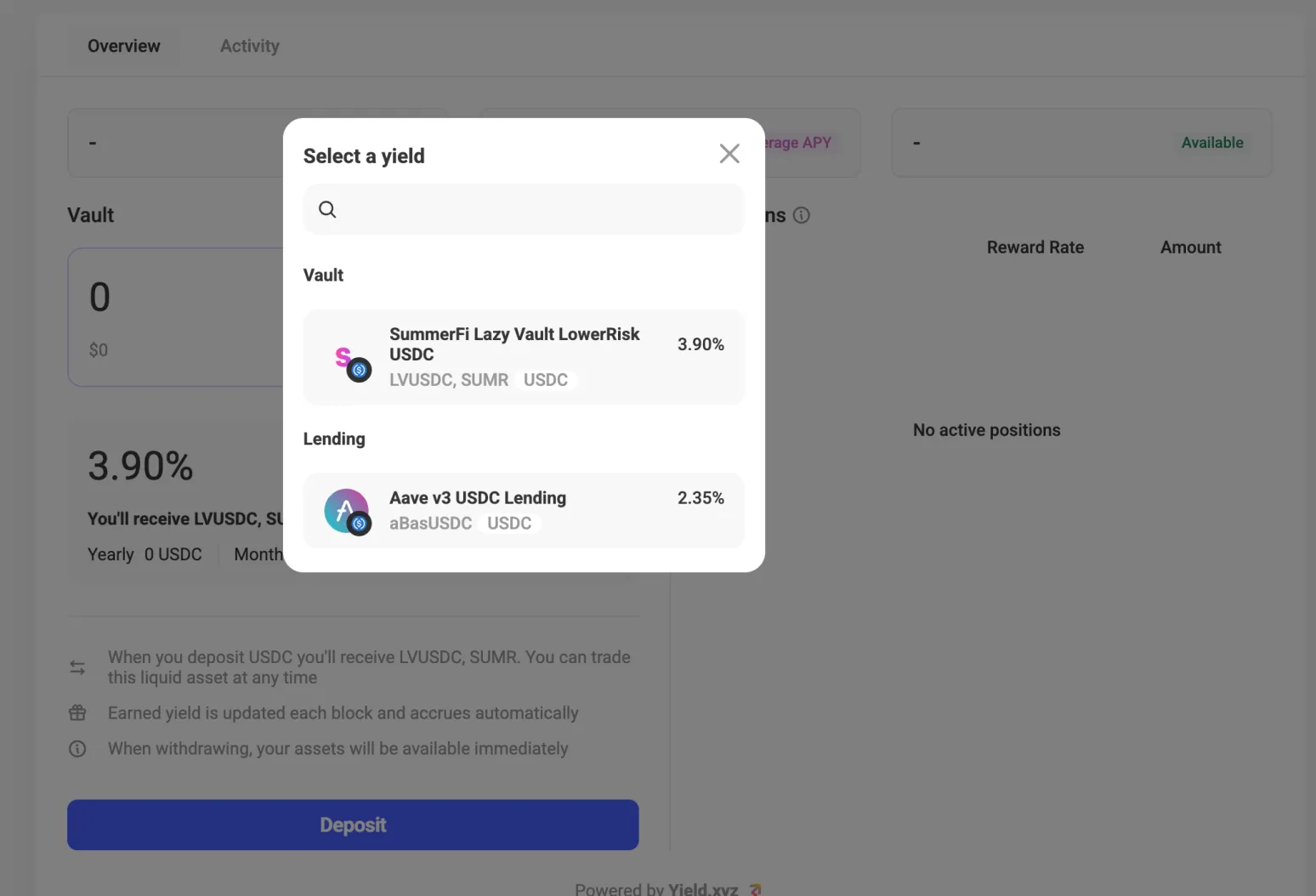
Base: USDC Lower Risk Vault
Diversified across lending markets on Morpho (curated by Steakhouse, Gauntlet, and others), Moonwell, Aave V3, and Fluid on Base. Conservative allocation caps, broad venue diversification.
Base: EURC Lower Risk Vault
A Euro-denominated stablecoin yield through Morpho vaults curated by B.Protocol/Block Analitica, Gauntlet, and Steakhouse plus Aave V3 on Base. One of the first institutional-grade yield options for MiCA-compliant EURC. (More on the EURC vault in Summer.fi launch post.)
Ethereum: USDC Lower Risk Vault
Access to deep Ethereum mainnet lending liquidity across Morpho, Compound, Sky, Fluid, and others, 18 supported markets with allocation managed within Block Analitica's conservative risk framework.
Ethereum: USDC Higher Risk Vault
A higher yield tier for institutions with appetite for expanded exposure, that allows for greater concentration. This vault targets the highest-yielding opportunities across established protocols, including sources from Morpho curators like Steakhouse, Gauntlet, and KPK, within a transparent, governance-defined risk framework.
Ethereum: USDT Lower Risk Vault (coming soon)
A USDT-denominated vault on Ethereum is currently in development, expanding coverage for institutions with USDT heavy treasuries.
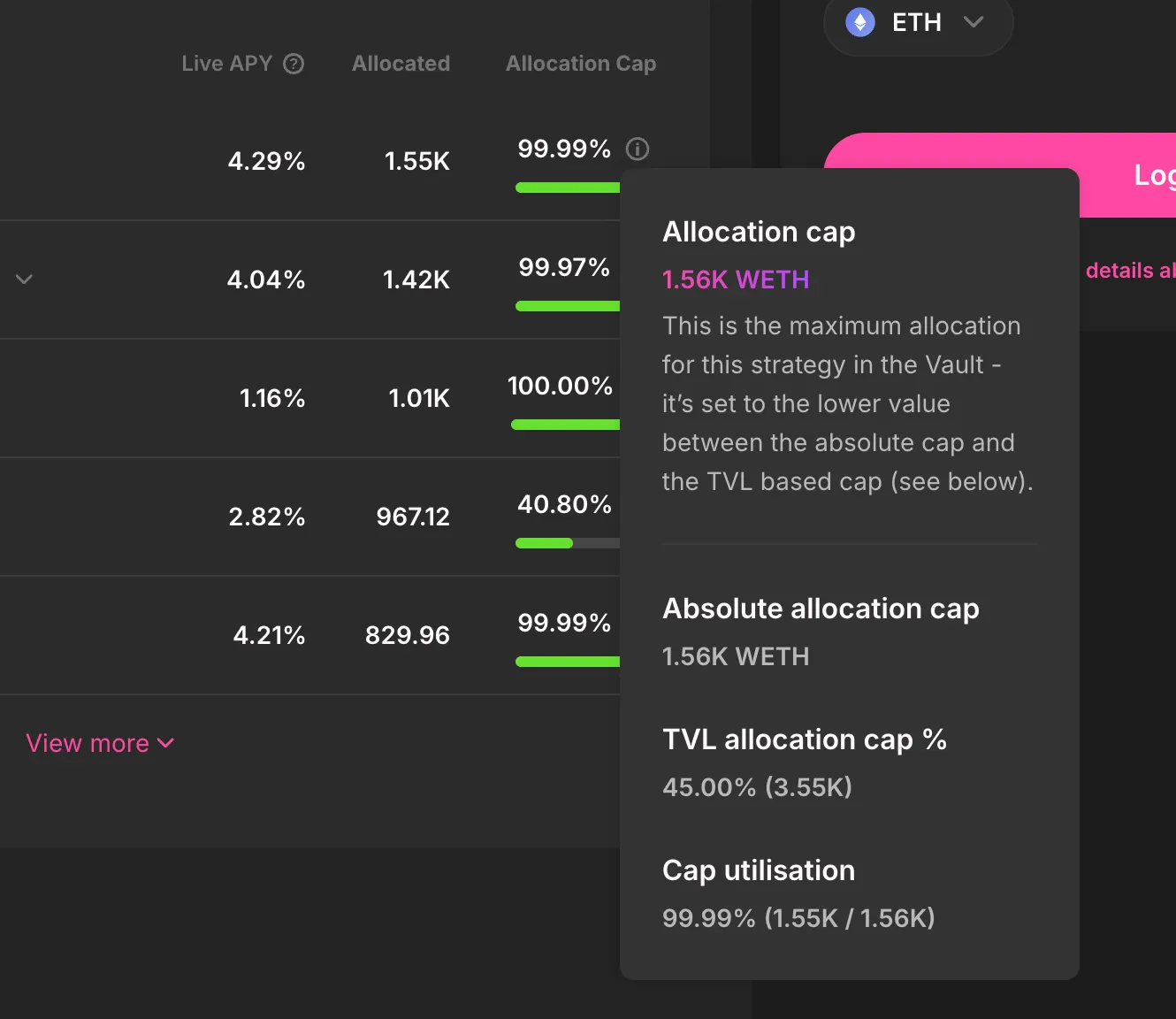
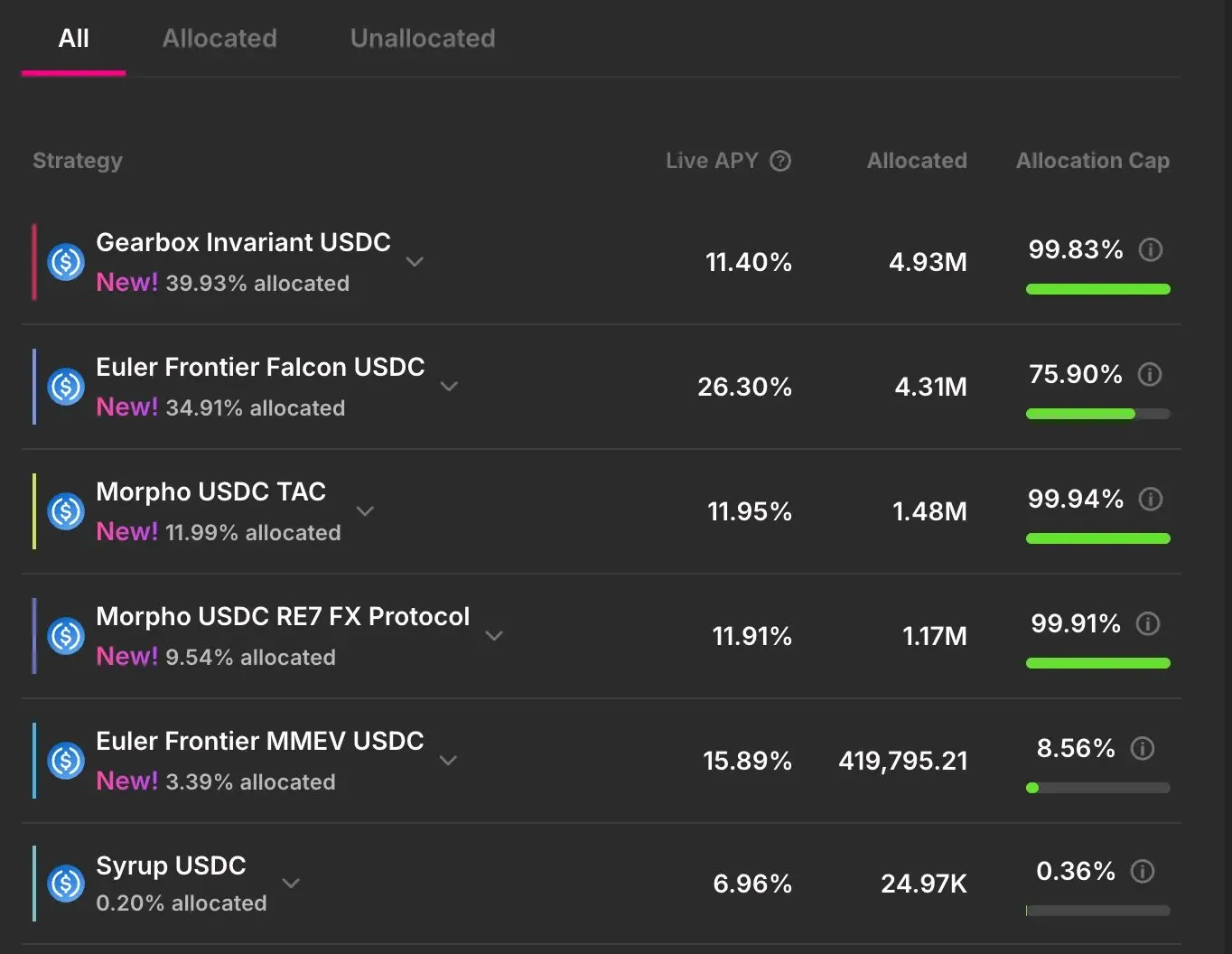
Each vault distributes capital across multiple protocols and curators rather than concentrating in a single venue. Allocation caps prevent over-exposure to any one market, if a new yield source is attractive but unproven, the cap might be set at just 5% of the total vault, giving the portfolio exposure to upside while keeping 95% protected if that source underperforms.
The Lazy Summer promise that is now available to institutions via Utila rests on three specific commitments
Above-benchmark yield.
Through diversified exposure across multiple yield sources that consistently outperform static, single-venue deposits.
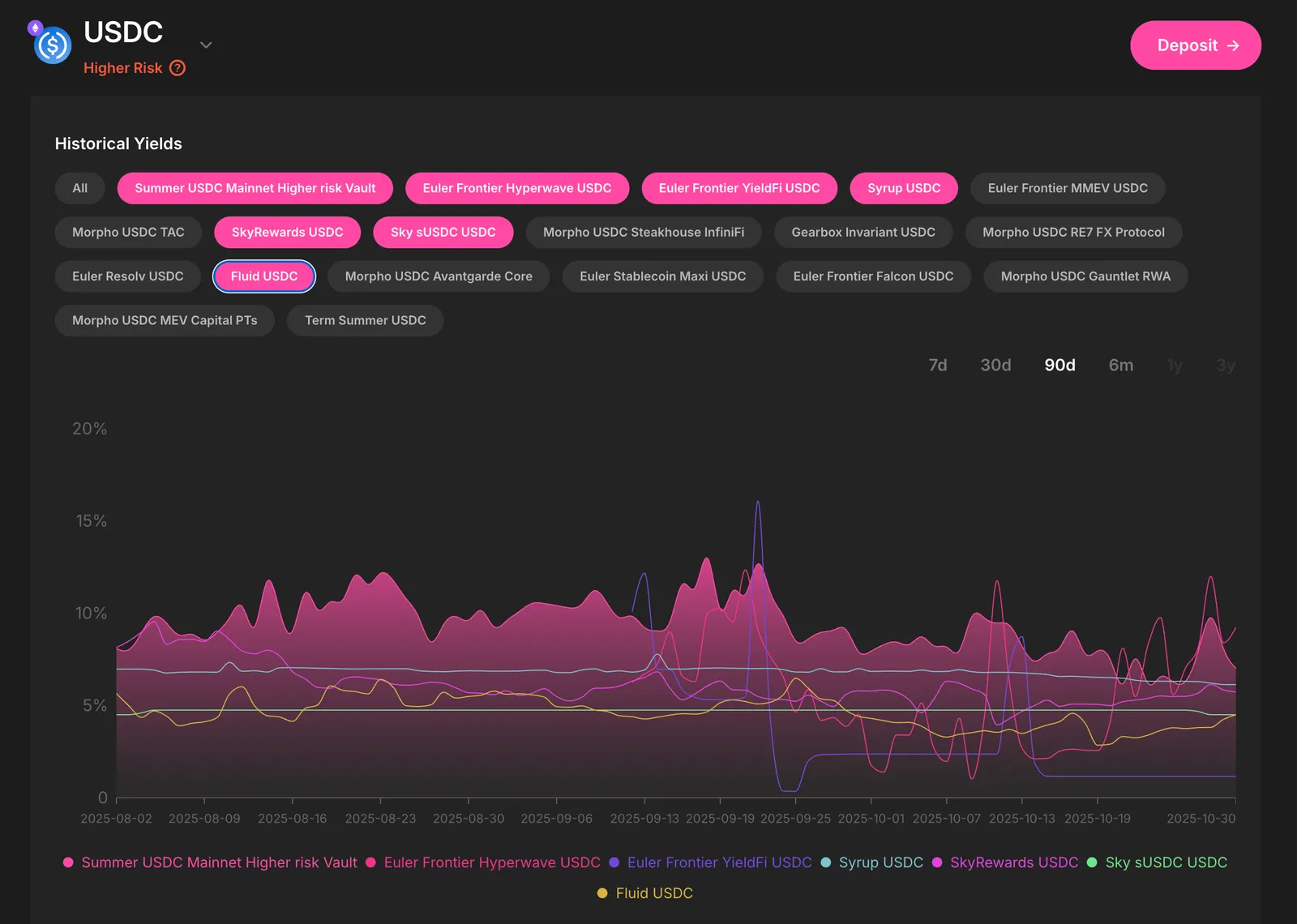
Risk curation, not yield chasing.
New yield sources are only added to vaults after passing through Block Analitica's governed risk framework. Every market has maximum allocation caps, every vault has an approved venue list that Block Analitica actively maintains. Adding sources that meet their criteria, removing sources where risk profiles have deteriorated.
Automation that removes the operational burden.
AI-powered Keepers handle the continuous work of monitoring rates, rebalancing allocations, and executing rotations across protocols. Over 75,000 automated rebalance actions happened in 2025 alone. Institutions deposit into a vault, and the system handles rotation automatically, no DeFi operations desk required.
Why this matters for institutions
The Gauntlet x Utila joint report maps the responsibilities required for institutional DeFi yield across three layers - risk management, vault infrastructure, and the execution layer - and argues that institutions need all three to be professionally managed.
Lazy Summer on Utila addresses exactly this stack: Block Analitica provides the risk layer, Lazy Summer provides the vault infrastructure and automated execution, and Utila provides the access via institutional custody.
Capital never leaves Utila's secure MPC wallet environment, treasury teams retain full operational visibility, policy controls, and audit trails, there is no requirement to bridge assets to an unfamiliar interface or relinquish custody.
Use cases
Digital Asset Treasury Companies
Lazy Summer vaults allow DATs to deploy stablecoin or ETH holdings into diversified, risk-managed yield strategies that are compatible with public company reporting standards, with performance that has consistently outpaced static single-venue deposits and benchmark yields, like staking.
Stablecoin issuers
For stablecoin issuers, the main use case is managing reserves that must meet redemption obligations while generating yield. The Lower Risk vault tier, with its conservative constraints and broad diversification, offers a deployment option aligned with the conservative requirements of reserve management. The addition of the EURC vault makes this particularly relevant for European issuers navigating MiCA compliance.
Fintechs
Seeking to offer yield-bearing products to end users, Lazy Summer's vault infrastructure, accessible through Utila, allows fintechs to embed institutional-grade yield into their product stack without the complexity of managing DeFi protocol integrations directly.
Corporate treasuries
Holding stablecoins as working capital or operational reserves, automated rebalancing and risk-managed diversification allow treasury teams to generate yield without dedicating headcount to DeFi operations.
To learn more about Summer.fi Institutional contact:
Anthony Fernandez, Head of Business Development
Email - Anthony@summer.fi
Book a discovery call at: calendly.com/summer-fi/summer-institutional
Visit Summer.fi institution website at: summer.fi/institutions
Access Summer.fi services via Linktree at: https://linktr.ee/Summerfi
Disclaimer: Oazo Apps Limited functions solely as a front-end interface (Summer.fi) provider and it does not act on behalf of any user. Oazo Apps Limited did not launch nor does it operate or control the Lazy Summer Protocol. The Lazy Summer Protocol is accessed through Summer.fi. The information provided herein is provided on behalf of the Lazy Summer Foundation which launched the Protocol for informational purposes only and it does not constitute investment advice. Oazo Apps Limited and the Lazy Summer Foundation are not soliciting or recommending any transaction or guaranteeing any specific returns. Users interact with the Protocol at their own risk. T&C for the use of Summer.fi apply.