
Inside the DAO-Managed Higher-Risk Vault: How WETH Moves Across DeFi’s Leading Lending Markets

For most of DeFi’s history, earning yield meant manually managing positions across multiple protocols.
Users would:
- Deposit into a lending market
- Monitor interest rate changes
- Rotate capital when better opportunities appeared
- Repeat the process constantly
As the ecosystem matured, a different approach began to emerge.
Instead of individuals managing dozens of positions, vault frameworks started acting as strategy layers for DeFi.
The ETH Higher Risk Vault is one example of this evolution.
Rather than depositing WETH into a single lending pool, the vault allocates capital across several lending markets through a structured DAO risk-managed framework in the Lazy Summer Protocol.
Inside the ETH Higher Risk Vault
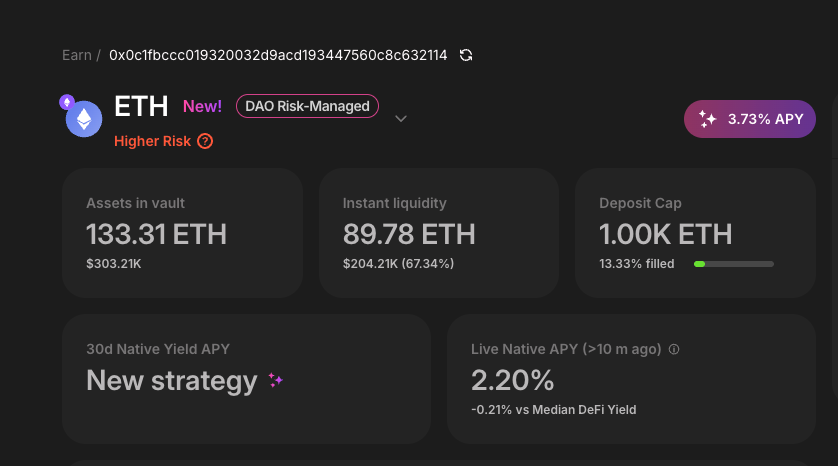
What the ETH Higher Risk Vault Does
The ETH Higher Risk Vault provides exposure to multiple DeFi lending markets through a single position.
Instead of manually moving WETH between protocols, the vault distributes liquidity across curated markets where borrowing demand and yield opportunities exist.
The position referenced in this article can be explored here: https://summer.fi/earn/mainnet/position/0x0c1fbccc019320032d9acd193447560c8c632114
At the time of writing, allocations include lending markets such as:
- Morpho WETH Alpha Core
- FluidLite WETH
- Morpho WETH Yearn OG
- Morpho WETH SingularV
- Morpho V2 WETH KPK Prime
Each of these markets represents a different lending opportunity within the broader DeFi ecosystem.
Why DAO Risk-Managed Vaults Exist
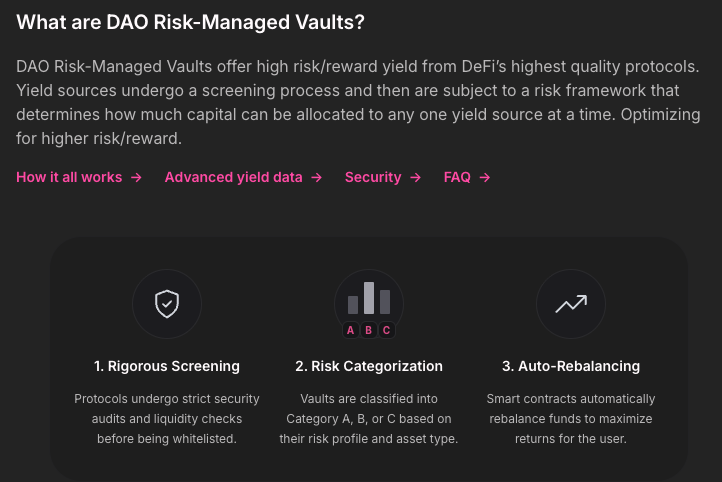
The ETH Higher Risk Vault belongs to a category known as DAO Risk-Managed Vaults.
These vaults were introduced to serve users seeking exposure to higher risk / higher reward DeFi strategies, while still operating inside a structured governance framework.
According to Summer.fi, these vaults combine the following:
- Automated capital allocation
- Governance-defined risk parameters
- Curated protocol integrations
The goal is not to remove risk higher-yield opportunities inherently carry higher risk but to structure how those risks are managed.
Read the full explanation here:
 Jordan Jackson
Multi-Market Allocation: Why It Matters
Yield conditions across DeFi change constantly.
Interest rates on lending platforms depend on:
- Borrower demand
- Available liquidity
- Protocol incentives
- Market volatility
Because of this, strategies concentrated in a single protocol can quickly become inefficient.
Multi-market vaults address this by distributing capital across multiple lending markets simultaneously.
Instead of committing liquidity to one protocol, the vault can maintain exposure across several markets at once.
This helps reduce the operational burden for users who would otherwise need to monitor each market individually.
Governance and Risk Management
One of the defining characteristics of DAO risk-managed vaults is that strategy parameters are defined by governance.
The DAO determines:
- Which protocols can be integrated
- Maximum exposure limits per strategy
- Deposit caps for risk control
- Incentive programs for vault growth
Risk parameters are developed with the support of Block Analitica, a long-time risk management partner in the ecosystem.
Block Analitica evaluates yield sources and helps define guardrails that shape how vault capital is allocated.
This governance structure ensures vault strategies operate within transparent and predefined limits.
Automated Rebalancing
Another key component of the vault architecture is automation.
The vault uses keeper infrastructure to monitor market conditions and adjust allocations as opportunities change.
This allows the strategy to rebalance between lending markets without requiring users to manually move their capital.
Instead of managing multiple positions across protocols, users interact with a single vault position that continuously adapts to market conditions.
A Shift Toward Onchain Asset Management
Vaults like the ETH Higher Risk Vault reflect a broader shift in DeFi.
Early DeFi focused heavily on individual yield farming strategies.
Today, the ecosystem is gradually moving toward onchain asset management frameworks, where vaults coordinate strategies across multiple protocols.
In this model:
- Users hold vault positions
- vaults manage protocol interactions
- Governance defines risk parameters
This architecture allows strategies to evolve as the ecosystem grows.
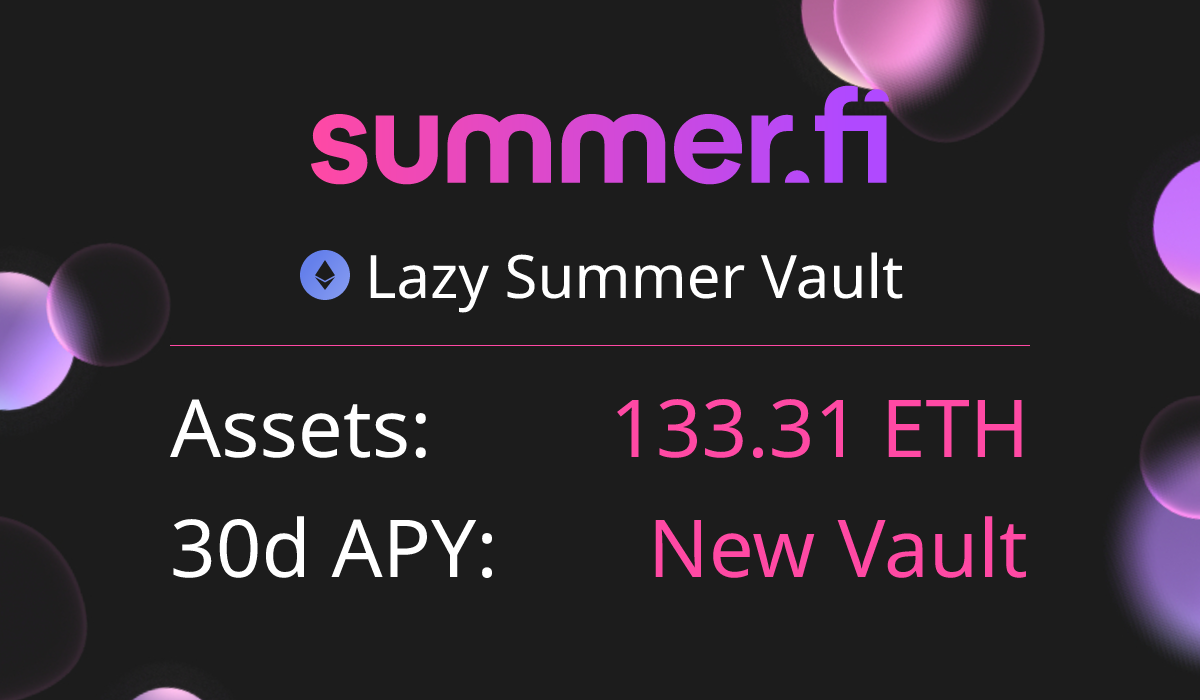
Explore the ETH Higher Risk Vault
To see the current vault allocations and strategy structure, explore the position here:

Key Takeaways
- The ETH Higher Risk Vault allocates WETH across multiple DeFi lending markets.
- Strategies currently include lending markets from Morpho and Fluid.
- Vault behavior is governed through a DAO risk-managed framework.
- Risk parameters are developed with Block Analitica.
- Automation and keeper infrastructure help rebalance capital between strategies.
Join us
Discord | Telegram | X/Twitter | Linktree
Disclaimer: Oazo Apps Limited functions solely as a front-end interface (Summer.fi) provider and it does not act on behalf of any user. Oazo Apps Limited did not launch nor does it operate or control the Lazy Summer Protocol. The Lazy Summer Protocol is accessed through Summer.fi. The information provided herein is provided on behalf of the Lazy Summer Foundation which launched the Protocol for informational purposes only and it does not constitute investment advice. Oazo Apps Limited and the Lazy Summer Foundation are not soliciting or recommending any transaction or guaranteeing any specific returns. Users interact with the Protocol at their own risk. T&C for the use of Summer.fi apply.