
5 Things That Will Drive Institutional Crypto Adoption in 2026
There's a window opening for crypto’s role in the financial system. A specific, 12-month window that will determine whether blockchain becomes core infrastructure for global capital markets or stays on the margins.
Samara Cohen, BlackRock's Global Head of Market Development, laid it out directly: the decisions made by policymakers and market shapers over the next 6 to 12 months regarding blockchain integration will fundamentally shape global capital markets for the next decade.
When the person responsible for market development at the world's largest asset manager says there's a ticking clock, it's worth understanding what specifically she thinks needs to happen.
Here are the keys she is thinks are worth prioritizing.
Key 1: Solve the oracle problem before scale, not after
Before talking about what's coming, it's worth understanding what almost went wrong.
Cohen reflected on recent crypto market volatility, specifically the "October 10th event" and made a clear point: market resilience must be the top priority before massive scale is achieved.
The specific failure point: the "oracle problem." During market stress, flawed or delayed pricing data led to cascading failures . Every institutional risk model, every compliance check, every margin call depends on accurate, real-time pricing. In traditional finance, this infrastructure has been battle-tested through decades of crises. If onchain markets can’t have similar amounts of resilience and guarantees, the game has finished before its begun.
The oracle problem manifests as:
- Stale price feeds during high volatility
- Single-source pricing dependency becoming systemic risk
- Cross-chain inconsistency on the same asset
- Liquidation cascades triggered by delayed updates
Cohen's argument: robust valuation clarity is essential for institutional trust. Without it, institutional capital stays on the sidelines regardless of how compelling the yield or efficiency arguments are.
Chainlink, Pyth, and custom institutional feeds are making progress, but the point is this needs to be solved before scale, not after and the next 12 months is when it gets stress-tested with real institutional capital.
Key 2: Think about tokenization as ETFs 2.0
Cohen framed tokenization in a way that should resonate with anyone who has watched the ETF revolution unfold.
BlackRock views ETFs as the most significant market disruption of the past 25 years because they drastically expanded investor access to diversified strategies. Tokenization is the next logical chapter of this exact same mission - delivering better investment outcomes and utility to a broader base of investors.
This framing matters because it tells you how BlackRock is thinking about the opportunity. Not as a crypto experiment, but as the next evolution of the same market structure innovation that built their business.
- ETFs took illiquid baskets and made them liquid → Tokenization takes siloed assets and makes them composable and flexible.
- ETFs standardized exposure → Tokenization standardizes settlement and composability.
- ETFs reduced costs through structural efficiency → Tokenization reduces costs through programmable infrastructure.
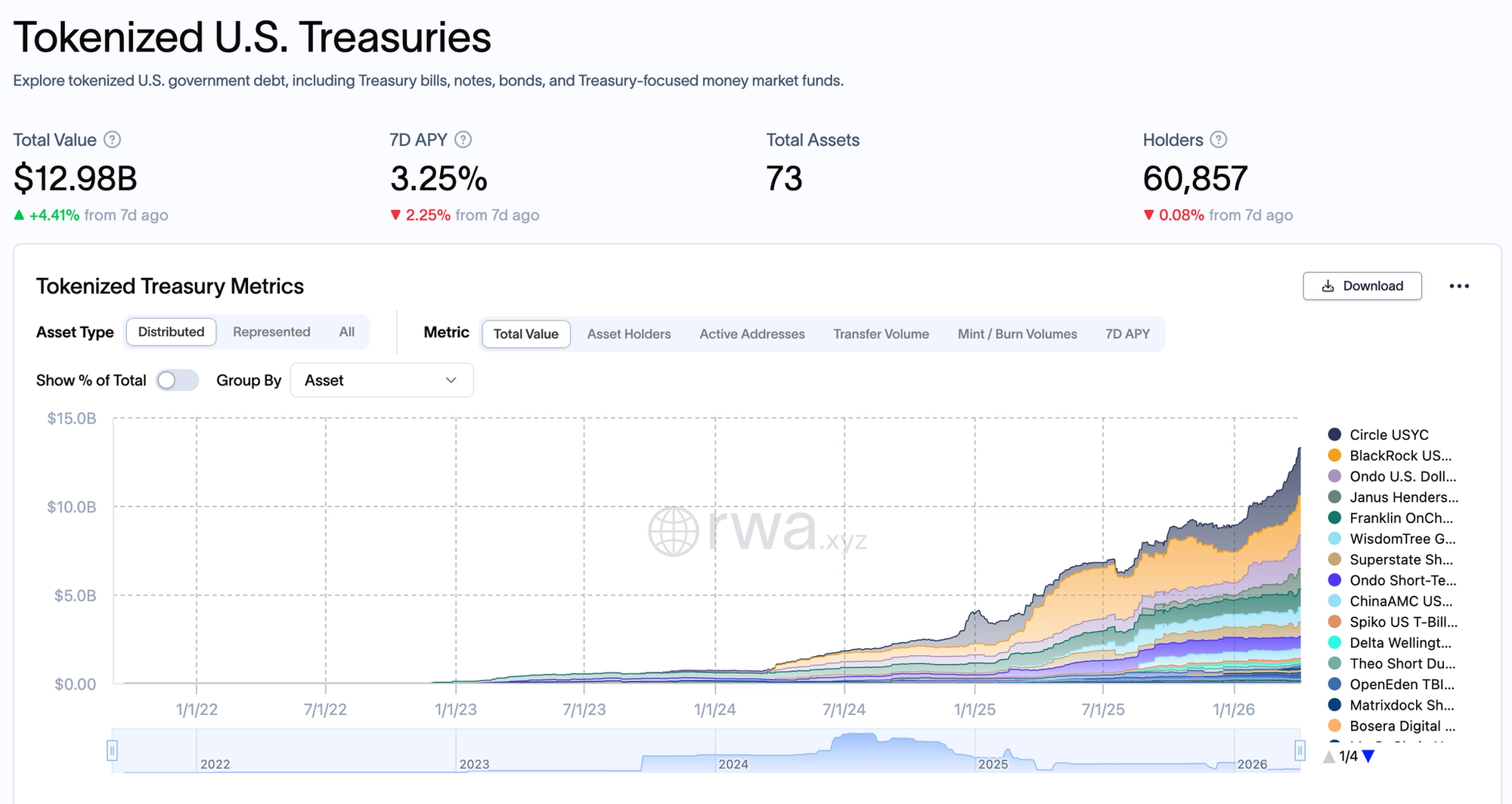
The tokenized Treasury market has crossed $5B in TVL (per rwa.xyz data), led by BlackRock's BUIDL, Ondo's OUSG, and Franklin Templeton's BENJI. But the real opportunity mirrors ETF history, ETFs didn't just replicate existing products, they enabled entirely new strategies. A tokenized Treasury isn't just a Treasury. It's composable collateral that can sit in lending protocols, anchor yield strategies, and serve as the risk-free rate for all of onchain finance.
https://app.rwa.xyz/treasuries
Key 3: Navigate the transatlantic divide
One of the most underreported dynamics: the US and Europe are heading down distinctly different paths on digital money.
The US is establishing a framework anchored by highly regulated private stablecoins (the GENIUS Act). Europe is focused on launching a Euro CBDC and tokenized bank deposits.
For institutional players operating globally, this divergence creates real complexity. Cross-border settlement between a US stablecoin framework and a European CBDC framework will require bridging infrastructure that doesn't fully exist yet. The protocols and platforms that solve this interoperability will capture significant value in the coming years.
Key 4: Pay attention to prediction markets
Cohen pointed to something most institutional observers are still sleeping on: prediction markets are moving beyond sports betting and gathering serious financial assets.
Feeds from Polymarket and Kalshi now appear on Bloomberg terminals and they are increasingly acting as informational infrastructure for traditional finance.
For institutional portfolio managers, this represents a new data layer - real-time probability estimates on everything from macro events to policy outcomes. This data is already being integrated into institutional workflows, which signals the speed at which onchain data sources are becoming part of traditional finance infrastructure.
Key 5: Build for open architecture, resilience, and investor experience
Cohen outlined three traits infrastructure providers must exhibit to win in the coming year:
- Open architecture: Composability and interoperability over walled gardens. The institutions that built TradFi through proprietary silos will find that onchain markets reward the opposite.
- Resilience and volatility safeguards: Circuit breakers, multi-source price feeds, battle-tested liquidation mechanisms. Institutional capital requires confidence the infrastructure won't break during stress.
- Investor centric design: Abstracting blockchain complexity while preserving the benefits of onchain settlement and composability. The UX gap between TradFi and DeFi remains significant.
For yield strategies specifically, Cohen described a shift away from hyper-specific siloed analytics toward more robust general rebalancing strategies that ensure broad market alignment and resilience across open architectures.
What this means for onchain yield seekers
The convergence between institutional finance and onchain infrastructure is entering its decisive phase. Cohen's timeline reflects real legislative calendars (GENIUS Act, CLARITY Act), real product launches (tokenized funds, institutional DeFi vaults), and real infrastructure milestones.
Every tokenized Treasury, every institutional lending facility, every robust oracle network creates yield backed by real economic activity, not recursive token emissions. The protocols positioned at this intersection, with open architecture, institutional-grade resilience, and composability across yield sources, will capture the wave.
Summer.fi institutional is especially well positioned to enable yield seekers to earn the best tokenized RWA yield strategies in an automated and compliant manner.
Sources:
- Samara Cohen, Global Head of Market Development, BlackRock - interview on institutional tokenization at DAS by Blockworks
- rwa.xyz - tokenized Treasury market data (https://app.rwa.xyz/treasuries)
- GENIUS Act, CLARITY Act - US regulatory frameworks